
The Complete Guide to Buying a T-Shirt You’ll Actually Wear — Your Shopping Toolkit
Welcome back. If you’re just finding this, you’ll want to start with Part 1 — it covers the drawer audit, necklines, sleeves, and fit, and it sets the foundation for everything here.
If you’ve already read it, you’re in exactly the right place. This is the practical side, what to feel for in the store, how to spot quality before you try anything on, what to spend, where to shop, and how to care for what you bring home.
By the end of this you’ll be ready to walk into a store — or open a browser — and actually find what you’re looking for. Let’s go.
Fabric — Probably the Most Important Thing in This Guide
If T-shirts have felt frustrating, this is often why. Most women think their only options are regular cotton or a synthetic blend. There’s a whole middle ground worth knowing about, and it might be exactly what’s been missing.
Before you buy anything, feel the fabric in your hands. Pick it up. Stretch it a little. Does it snap back or go limp? Does it feel substantial or almost see-through? That tells you a lot before you ever try it on.
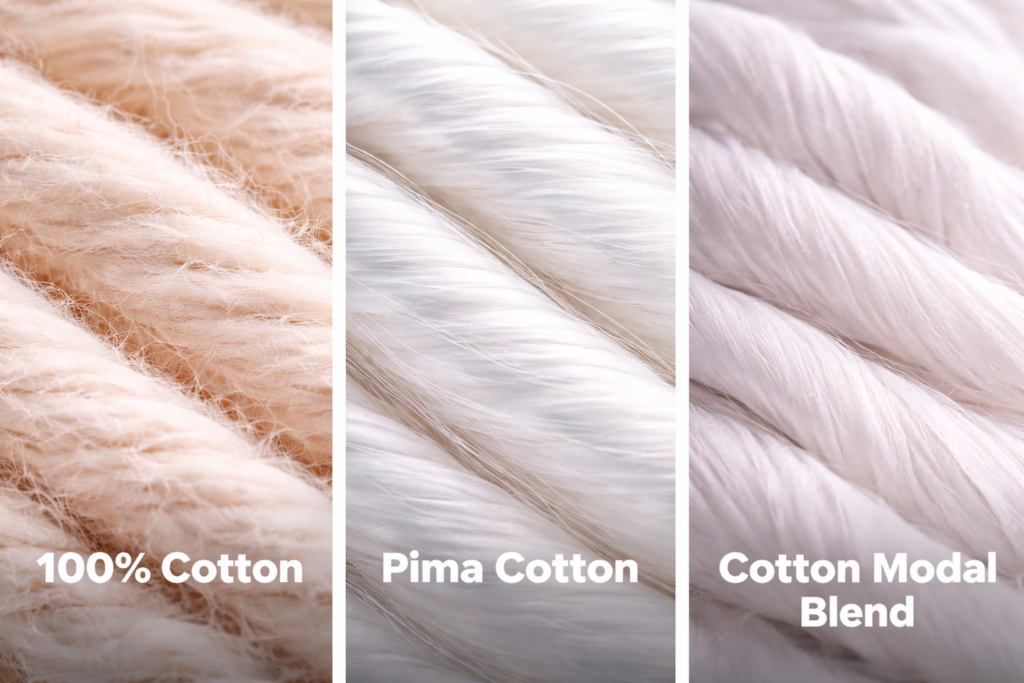
Regular 100% Cotton
This is what most of us grew up wearing. It’s familiar and breathable, but it can also feel stiff, cling in places you don’t want it to, and fade or lose its shape faster than you’d like. It’s not always the enemy, but it’s not always your best option either. Especially now.
Pima Cotton
Pima cotton is worth knowing about. It’s still a natural fiber — so it feels familiar and trustworthy — but the fibers are longer and finer, which makes it noticeably softer and much stronger than regular cotton. It holds its shape wash after wash. And here’s something a lot of women don’t connect until someone points it out: if you’ve experienced pilling where your arms rub against your body, Pima is often the answer. That’s not your body doing something wrong. That’s your fabric not being up to the job.
Modal and Cotton-Modal Blends
Modal is incredibly soft and it drapes beautifully instead of grabbing onto your body. It has a more relaxed, effortless feel to it. Some women absolutely love that quality. It skims rather than clings and feels very forgiving. It can be a little more prone to pilling over time and has a softer, more loungy quality than Pima. But for the woman who wants that easy, effortless fit it can be exactly right.
None of these is better than the others. They just do different things for different women. Now you know enough to find the one that works for you.
Construction — How to Tell If It’s Actually Worth Your Time
A T-shirt will tell you almost everything you need to know before you ever set foot in a dressing room. Here’s what to look for.
The Seams
Hold the shirt up and look at how it hangs. The seams should run straight, not twist to the front or the back. If it’s already twisting on the hanger, it will twist on your body.
Nothing will fix that.
The Neckline
A well-made neckline holds its shape. If it already looks stretched out, wavy, or uneven before anyone has worn it — PUT IT BACK!
Now here’s something most women never think to do: flip it over and look inside the neckline. What you’re looking for is a band of fabric that runs all the way around the inside. That band is what gives the neckline its structure and keeps it from stretching out and losing its shape after a few washes.
If you see a simple folded edge stitched down with no band behind it, that neckline is already telling you it won’t hold up over time. That’s often the whole reason a neckline goes wavy and shapeless after a season.
The Stretch Test
Give the neckline a gentle stretch. It should bounce back immediately — snapping back to its original shape. If it stays pulled out or goes limp in your hands, that fabric is already done.
Once you start seeing these things — the twisting seams, the missing band, the neckline that won’t recover — you will not be able to unsee them. That’s a good thing. That’s you shopping smarter.
Price — What You’re Actually Paying For
A $10 T-shirt isn’t really $10, not if it goes thin after two washes, loses its shape by summer, and you’re replacing it again next spring. That’s cost per wear. And once you start thinking that way, shopping feels very different.
A $38 tee you wear 30 times costs you about $1.25 per wear. A $10 tee you replace three times a year costs you $30 — plus the frustration of nothing ever feeling quite right.
On the other end — you don’t need to spend $100 on a white tee. What I’ve found is that somewhere around $30 to $45 is usually the sweet spot. That’s where better fabric, better construction, and a neckline that holds its shape after a dozen washes starts to show up consistently.
And here’s something worth remembering: quality doesn’t always announce itself with a big price tag. Sometimes it’s a $38 tee from a brand you’ve never heard of that outlasts a $75 one from a name you have.
That’s why everything we’ve covered matters, you now know how to recognize quality when you see it, regardless of what the tag says.
Where to Shop
Here are some of my favorite places to look, across a range of price points:
For the sweet spot — Banana Republic, GAP, J.Crew, Madewell, LOFT, J.Jill, and Nordstrom are all worth your time. Ralph Lauren and Rag & Bone if you’re looking to invest in something that will last for years. Kohl’s and Walmart genuinely come through at an accessible price point — just go in knowing what you’re looking for and you’ll be fine.
A word on factory stores: I find the quality inconsistent and I’d rather see you spend a little more at the main store than less at the outlet.
Same goes for off-price retailers like Marshall’s, Ross, and TJ Maxx, occasionally you’ll find a gem, but it takes patience and a good eye. Now that you’ve read this guide, you have that eye.
Care — How to Protect What You’ve Invested In
Most T-shirts don’t get replaced because of fit. They get replaced because of stains, fading, and not knowing how to care for what you bought. A little attention here goes a long way.
For White Tees — Stains and Yellowing
Deodorant buildup, yellowing, that dull dingy look that creeps in over time, try this before you give up on it. A little baking soda and peroxide, or a good stain remover, worked into the underarm area and left to sit before washing.
Sometimes you can bring it back.
Sometimes you can’t. But you owe it to your investment to try first.
For Any Color Tee — Fading
Check the care label before you buy. If it says wash separately or wash with like colors, that’s the manufacturer telling you the dye isn’t fully stable. That’s worth knowing before it ends up in your washing machine with everything else.
Once it’s home — turn it inside out before every wash. It’s one of the simplest things you can do to protect the color and it takes about two seconds.
Washing and Drying
Wash in cold water and skip the dryer when you can. Hot water breaks down dye faster than almost anything else. The dryer does the same thing to your fabric — aging it before its time. A tee that could hold its color and shape for years washed in cold can look tired in a season washed in hot.
The women who get years out of their clothes aren’t buying differently than you. They’re just caring for them differently.
You’re Ready. Here’s Your Next Step.
You’re Ready. Here’s Your Next Step.
Before you go anywhere near a store — take a few minutes and go through what you already own. Pull out every T-shirt and take an honest look.
The ones that always felt right are telling you something about what works for your body now. The ones that never quite worked?
Now you know why. Take that knowledge with you. It’s your best starting point before you ever touch a hanger.
Between Part 1 and Part 2 you now know what to look for in a neckline, a sleeve, a fit, a fabric, and a construction. You know what to spend and where to shop. And you know how to care for what you bring home so it actually lasts.
That’s not nothing. Most women never get that far.
Now go shopping for the woman you are right now. She deserves clothes that actually fit who she is today. And here’s everything you need to do exactly that.
If you haven’t taken the quiz yet — start there. Eight questions, about two minutes. It takes everything we covered and turns it into a personalized shopping guide, your neckline, your sleeve, your fabric, your fit — all in one place to screenshot and take shopping.
Click here to Take the free White Tee Quiz
And then click this link to download your free T-Shirt Guide.
Everything from this series in one beautiful document — a quick reference card to pull up on your phone in the store, the full guide to read before you go, the construction checklist, fabric explained, price and care.
All of it. Yours to keep.
Download The T-Shirt Guide: Shop Smart at Every Stage
Let your results be a starting point. And then let the dressing room surprise you — because sometimes the best discoveries happen when you’re just willing to try.
Have a question or not sure what you’re looking for? Send me a DM on Instagram or drop a comment below. That’s exactly what I’m here for.
Read Part 1: The Complete Guide to Buying a T-Shirt You’ll Actually Wear Start Here
Want to know more about T-Shirt fabrics? Printify Fabric Guide

This is a great guide Cindy – thank you! I’m definitely a t-shirt girl! Lately I’ve been having trouble finding v-necks/scoop necks, which are all I wear. Everything seems to be crew necks these days – and with a short neck, it leaves me feeling strangled. I just ordered a few v-necks from the Gap, thanks to your recommendation!
Hi Gina, Thanks for taking the time to share a comment. I am happy you found the guide helpful. I saw the Gap’s selection and they seemed to carry a nice variety of necklines. Let me know what you think of the ones you ordered. Thanks again!